



Have you ever looked at an opportunity that seemed perfect on paper, yet something inside you said, No, this isn’t right?
Or perhaps the opposite has happened. An opportunity didn’t make complete logical sense, but you felt a quiet pull toward it, a sense that you needed to explore it even if you couldn’t explain why.
This is intuition at work.
When we’re making important career and business decisions, we’re often taught to rely primarily on logic. We compare salaries, responsibilities, opportunities for advancement, financial projections, risks, market conditions, and all the other practical information available to us.
And we should.
But sometimes the information we can see doesn’t tell us the whole story.
Intuition adds another layer of intelligence to the decision-making process. It helps us notice what resonates, what feels misaligned, and what may deserve a closer look.
The challenge is learning how to recognize intuition—and distinguish it from fear, wishful thinking, anxiety, or simply wanting something to be true.
What Does Intuition Actually Feel Like?
Intuition isn’t always dramatic.
You may not hear a clear inner voice telling you exactly what to do. More often, intuition communicates quietly.
It may show up as:
- a feeling of expansion or contraction in your body;
- an unexpected sense of knowing;
- a thought that keeps returning even after you’ve tried to dismiss it;
- curiosity about an opportunity you hadn’t previously considered;
- a subtle feeling that something isn’t quite right;
- a sense of peace around a decision, even when the decision itself feels challenging.
Sometimes intuition simply says, Pay attention to this.
That doesn’t necessarily mean say yes. It may mean investigate further, ask another question, have the conversation, apply for the position, reconsider the partnership, or wait before committing.
This distinction is important because intuition doesn’t replace your judgment. It gives you information that your rational mind can then explore.
Intuition vs. Fear: How Can You Tell the Difference?
This is probably one of the most difficult parts of intuitive decision-making.
Fear can be very convincing.
Imagine you’ve been offered a new position. It pays more and offers greater responsibility, but accepting it means leaving a company where you’ve worked for years.
Suddenly your mind starts producing reasons to stay:
What if I don’t succeed?
What if I regret leaving?
What if the new company isn’t what I expect?
What if I lose the security I already have?
It would be easy to interpret that discomfort as intuition telling you not to take the job.
But discomfort doesn’t always mean no.
Sometimes discomfort means new.
Fear tends to be noisy. It creates scenarios, asks endless “what if” questions, and tries to predict everything that could go wrong.
Intuition is often quieter and simpler.
Fear might say:
Don’t do it. What if you fail? What if you lose everything? You should stay where it’s safe.
Intuition might simply say:
This isn’t right.
Or:
You need to explore this.
One creates a spiral. The other often feels more like information.
Here’s a simple way to recognize some of the differences between intuition and fear:
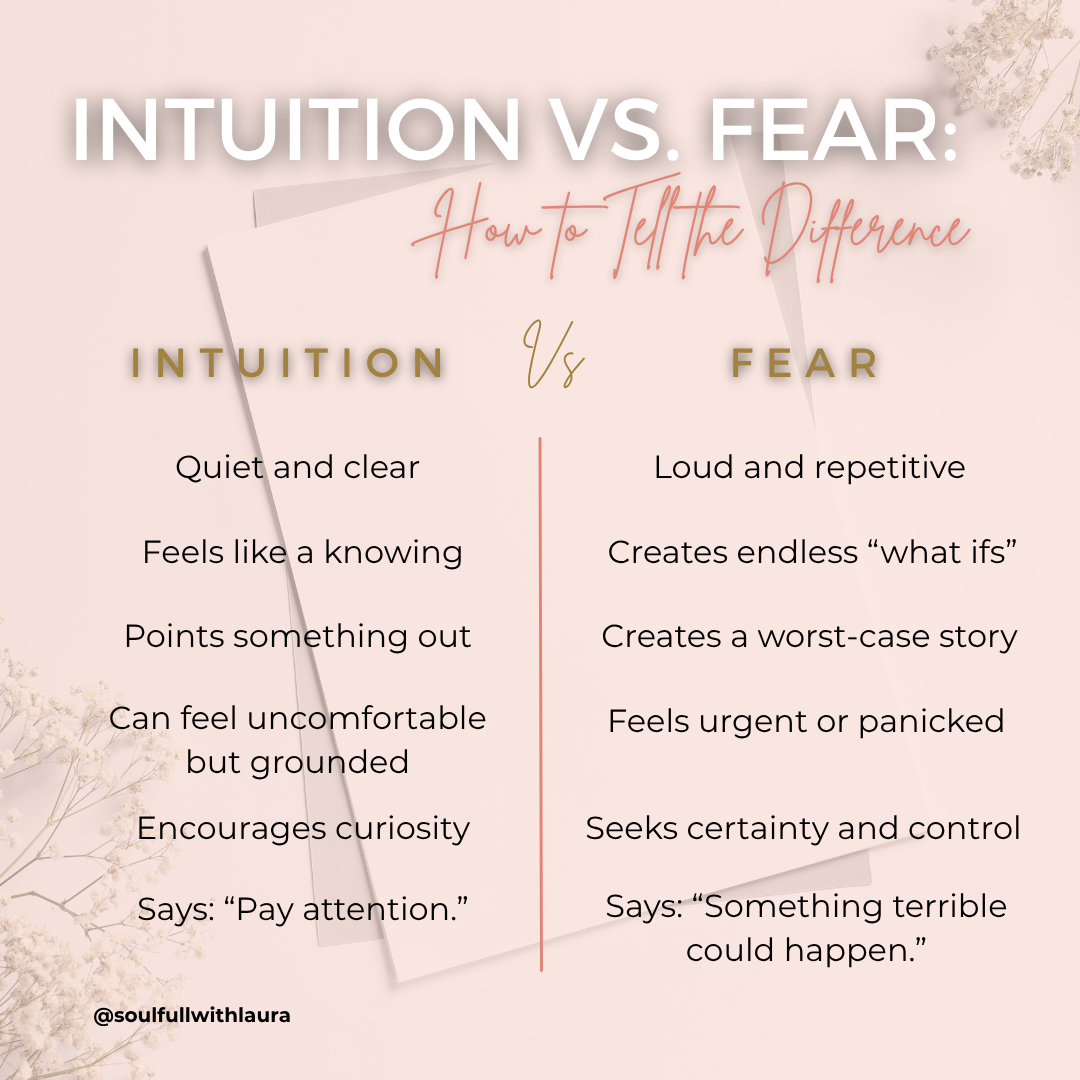
Discomfort doesn’t always mean no. Sometimes discomfort means new.
When Logic and Intuition Disagree
There are times when everything looks right logically, but something still feels wrong.
Suppose you’re considering working with a potential client. Financially, it’s a great opportunity. The project is exactly the kind of work you’ve been trying to attract.
Yet after every conversation with this person, you feel uneasy.
Instead of ignoring that feeling—or immediately deciding that your intuition is telling you to walk away—get curious.
Ask yourself:
What specifically am I noticing?
Perhaps the client repeatedly pushes against your boundaries. Maybe their expectations aren’t clear. Perhaps they’ve made comments that suggest they may be difficult to satisfy. Or maybe you’re recognizing a pattern you’ve encountered before.
Your intuition may have noticed something before your conscious mind has been able to name it.
Now you can bring logic back into the conversation.
Ask better questions. Clarify expectations. Review the contract. Look at the numbers. Gather more information.
Intuition and logic don’t have to compete.
Some of the strongest decisions happen when you allow them to work together.
Five Ways to Strengthen Your Intuitive Discernment
1. Create Space Before You Decide
It’s difficult to hear your intuition when your mind is overloaded.
When possible, avoid making an important decision immediately. Step away from the email, proposal, job offer, or spreadsheet.
Take a walk. Meditate. Journal. Sleep on it.
Then return to the decision and notice what is still present when the initial emotional reaction has settled.
2. Pay Attention to Your Body
Your body often responds before your mind has finished analyzing a situation.
Imagine each option separately.
What happens?
Do you feel relaxed? Energized? Heavy? Tight? Restless? Open?
This isn’t about treating every physical sensation as a prediction. It’s about becoming aware of the information your body is giving you.
Over time, you may begin to recognize your own patterns.
3. Separate the Facts From the Story
Take a piece of paper and create two columns.
In the first, write what you know.
In the second, write what you are assuming, fearing, or imagining.
For example:
Fact: The new position requires more travel.
Story: If I travel more, my entire personal life will become unmanageable.
Or:
Fact: My business revenue has been inconsistent for three months.
Story: My business is failing.
Separating facts from interpretations can make it much easier to hear what your intuition is actually saying.
4. Ask Better Questions
Instead of asking only:
Should I do this?
Try asking:
What am I not seeing?
What about this opportunity feels aligned?
What feels uncomfortable, and why?
Am I saying no because this isn’t right for me—or because I’m afraid of growing?
If fear were removed from this decision, what would I choose?
What additional information would help me make this decision confidently?
Good intuitive work isn’t just about receiving answers. It’s also about learning to ask better questions.
5. Keep an Intuition Journal
One of the best ways to learn whether you can trust your intuition is to study your own experience.
When you have a strong feeling about a career or business situation, write it down.
Record:
What did you sense?
What did you think it meant?
What did you decide?
What happened afterward?
Looking back several months later can be incredibly revealing.
You may discover that certain sensations consistently accompany good decisions. You may also discover situations where you thought you were following intuition but were actually responding to fear, attachment, excitement, or an old pattern.
That is how discernment develops.
Intuition Doesn’t Always Tell You to Take the Safe Path
Sometimes your intuition will guide you toward the practical choice.
Other times, it may keep drawing your attention toward something that doesn’t fit the plan you created for yourself.
Perhaps you’ve built a successful career but no longer feel fulfilled by it.
Perhaps you’ve been considering starting a business alongside your current work.
Maybe an unexpected job opportunity appears in an industry you hadn’t considered.
Or perhaps your business looks successful from the outside, but the way you’ve built it no longer reflects who you’ve become.
These moments can be uncomfortable because intuition doesn’t always prioritize familiarity.
It often asks us to become more honest.
Is this still what I want?
Does this path still reflect who I am becoming?
Am I choosing this because it is aligned—or because it is familiar?
Those questions can change the direction of a career or business.
But Intuition Still Requires Action
There is another side of intuitive work that doesn’t get discussed enough.
You can receive all the guidance in the world, but eventually you have to do something with it.
If you feel called toward a different career, research it.
If you’re curious about a position, apply.
If something feels wrong with a business partnership, have the difficult conversation.
If you’re considering an investment, examine the numbers and understand the risks.
If you sense your business needs to evolve, explore what that evolution could realistically look like.
Spiritual alignment isn’t passive.
Intuition can point toward the door. You still have to decide whether to open it.
Your Intuition Is Part of Your Inner Compass
Learning to trust yourself doesn’t mean believing that every feeling is intuition or that every intuitive impression will lead to the outcome you expected.
It means developing a relationship with your inner guidance while remaining grounded in reality.
Listen inwardly.
Ask questions.
Gather information.
Notice your patterns.
Use your judgment.
And then make the most aligned decision you can with the information you have today.
Because the goal isn’t to become someone who always knows exactly what will happen.
The goal is to become someone who knows how to listen to herself when it’s time to choose what comes next.
Much love,
Laura

